


Dr. Goodarzi is the Director of the Robson DNA Science Centre, … and is one of the two Deputy Directors of the University of Calgary’s Charbonneau Cancer Institute. He obtained his PhD from University of Calgary in 2005 and trained as a post-doctoral scholar at the Genome Damage and Stability Centre at the University of Sussex (UK) until 2010. In 2011, he opened his own laboratory at the University of Calgary’s Cumming School of Medicine. Between 2012-2022, he held the Canada Research Chair for Radiation Exposure Disease. In 2015, he was named one of Calgary’s Top 40 Under 40 for achievements in science and education. In 2016 he was made a “Peak Scholar” by University of Calgary President Elizabeth Cannon for his work in knowledge engagement and innovation in the community with regards to radon gas induced cancer. In 2018, he was selected as a TEDx speaker on how citizen based science can transform research. Dr. Goodarzi is also the founder and Scientific Director of The Evict Radon National Study, a transdisciplinary, national research project aimed at enabling research into understanding and engineering out lung cancer-causing radon gas exposure from the Canadian residential environment.
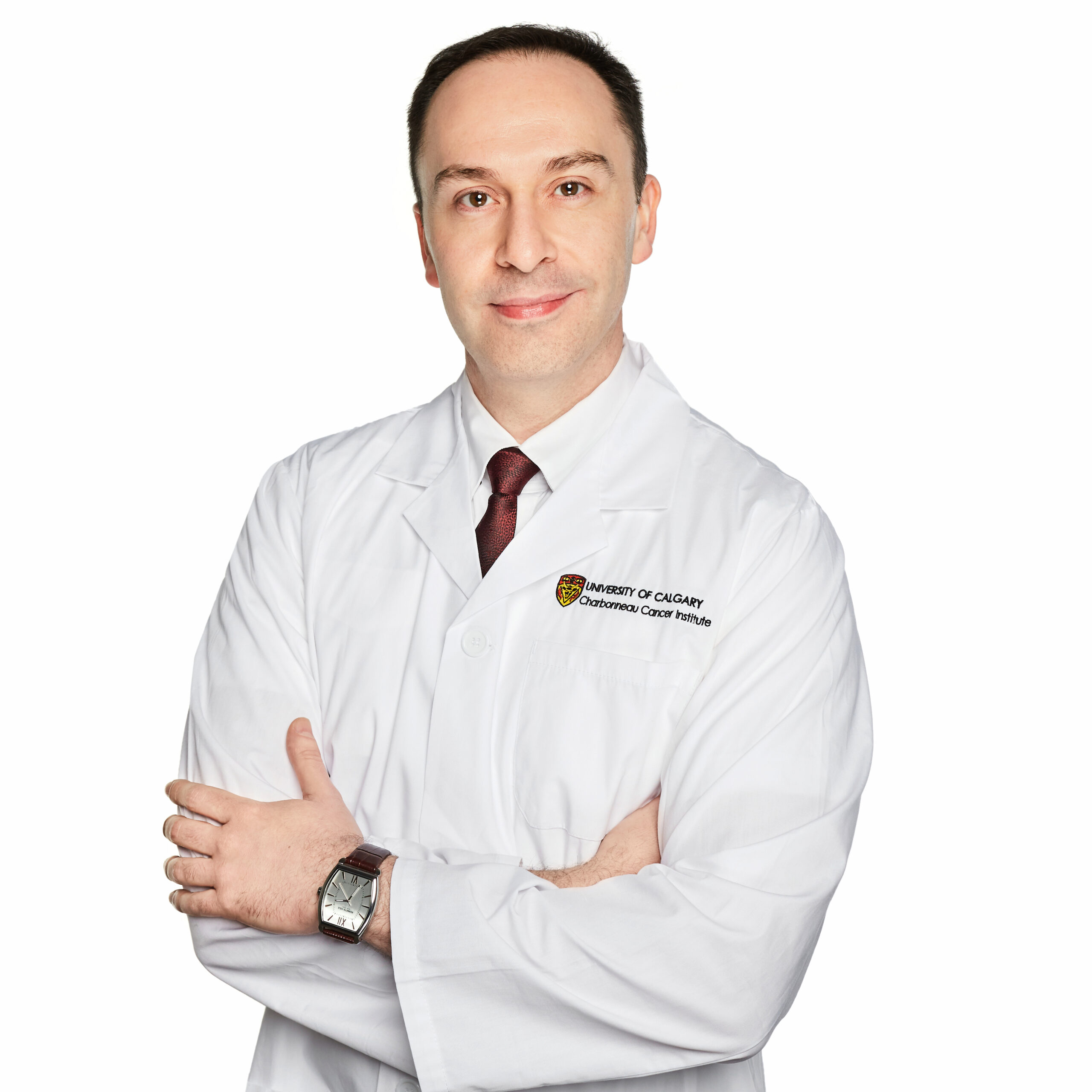
Goodarzi, Aaron
Fundamental Research
Professor
Biography
Area of Focus
- Enabling lung cancer prevention by understanding and finding new ways to reduce exposure to radon gas and alpha particle radiation
- Solving molecular mechanisms of chromatin dynamics during the human cellular response to oxidative DNA damage
- Studying genetic mutation patterns and variations linked to disease incidence and susceptibility (including cancer) in radiation exposed people
Summary of Research
From the moment of our conception, our DNA is subject to damage, the most serious being a break in both strands of the DNA. Unless these breaks are resealed correctly, whole segments of our genome can be lost or permanently mutated to fuel a self-propagating process of volatility that underlies cancer formation, radiation poisoning and/or premature cellular aging. My laboratory operates in a transdisciplinary manner, with ongoing projects in fundamental biology, population health, behavioural science, building science, policy, and atomic physical approaches to novel diagnostics and lab technology development.
Our wet lab science focuses on the study of ionizing radiation in the context of: (1) DNA damage repair in complex chromatin, (2) cellular oxidative stress responses and the role played by chromatin remodelling enzymes, (3) the developing brain of a child undergoing anti-cancer radiation therapy, and (4) the impact of repetitive, low-dose exposure to high linear energy transfer alpha particles emitted by radon gas, which is the leading cause of lung cancer in people who have never smoked. We also collaborate with other teams to use structural and integrative biology approaches to discern how chromatin remodelling enzymes function.
Our dry lab science involves wide-scale radon gas exposure testing and population health analyses that are aimed at understanding how the radiation emitted by radon impacts our bodies, and who may be the most at risk of developing lung cancer following long term radon gas exposure. We are advancing this by studying radon exposure as a function of the urban and rural built environment, how it can be (and is) modified by human behaviour and genetics, as well as the relationship between radon exposure, lung cancer risk and identity (sex, occupation, age, rural versus urban alignment, parental status, and more).
Discoveries in these areas are improving our knowledge of cancer formation, human ageing and radiation protection, and are aimed at reducing the future burden of lung cancer in Canada by developing meaningful, community-based interventions today. To test your home for radon whilst also contributing data to research, please visit www.evictradon.org for more information.
Area Of Focus
- Enabling lung cancer prevention by understanding and finding new ways to reduce exposure to radon gas and alpha particle radiation
- Solving molecular mechanisms of chromatin dynamics during the human cellular response to oxidative DNA damage
- Studying genetic mutation patterns and variations linked to disease incidence and susceptibility (including cancer) in radiation exposed people
Summary Of Research
From the moment of our conception, our DNA is subject to damage, the most serious being a break in both strands of the DNA. Unless these breaks are resealed correctly, whole segments of our genome can be lost or permanently mutated to fuel a self-propagating process of volatility that underlies cancer formation, radiation poisoning and/or premature cellular aging. My laboratory operates in a transdisciplinary manner, with ongoing projects in fundamental biology, population health, behavioural science, building science, policy, and atomic physical approaches to novel diagnostics and lab technology development.
Our wet lab science focuses on the study of ionizing radiation in the context of: (1) DNA damage repair in complex chromatin, (2) cellular oxidative stress responses and the role played by chromatin remodelling enzymes, (3) the developing brain of a child undergoing anti-cancer radiation therapy, and (4) the impact of repetitive, low-dose exposure to high linear energy transfer alpha particles emitted by radon gas, which is the leading cause of lung cancer in people who have never smoked. We also collaborate with other teams to use structural and integrative biology approaches to discern how chromatin remodelling enzymes function.
Our dry lab science involves wide-scale radon gas exposure testing and population health analyses that are aimed at understanding how the radiation emitted by radon impacts our bodies, and who may be the most at risk of developing lung cancer following long term radon gas exposure. We are advancing this by studying radon exposure as a function of the urban and rural built environment, how it can be (and is) modified by human behaviour and genetics, as well as the relationship between radon exposure, lung cancer risk and identity (sex, occupation, age, rural versus urban alignment, parental status, and more).
Discoveries in these areas are improving our knowledge of cancer formation, human ageing and radiation protection, and are aimed at reducing the future burden of lung cancer in Canada by developing meaningful, community-based interventions today. To test your home for radon whilst also contributing data to research, please visit www.evictradon.org for more information.